
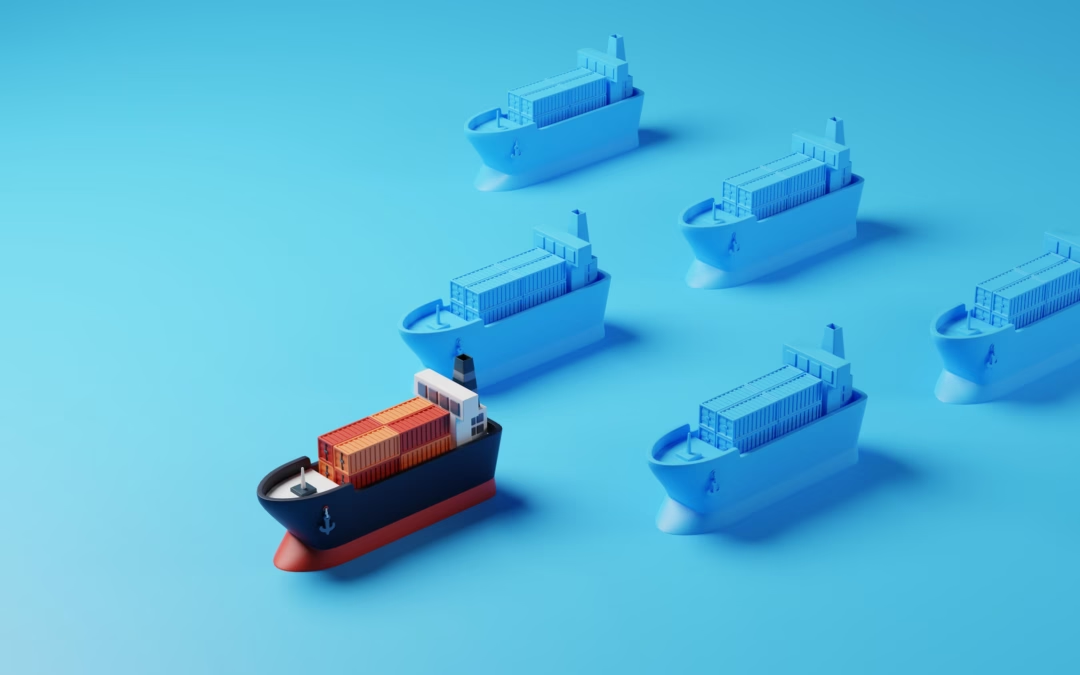
Carrier strategy stands out as one of the most consequential logistics decisions a growing brand makes. It is not just a matter of moving boxes from point A to point B. The route you choose dictates your operational success. This decision directly affects your bottom-line cost, delivery speed, network reliability, and the overall customer experience all at once.
Deciding on single carrier vs multi carrier shipping requires careful consideration of your current order volume and your future growth goals. To help you understand this complex topic, we put together a practical comparison of both models. By understanding the genuine strengths of each approach, brands can make a highly informed decision that supports their long-term supply chain goals.
What Is Single-Carrier Shipping?
Single-carrier shipping is a streamlined logistics model where one delivery provider handles all your outgoing shipments under a single contract. Instead of splitting your daily volume among various networks, you trust one logistics partner to handle everything.
This straightforward approach offers several genuine strengths for your operation:
- Simplified management: You deal with one monthly invoice, one dedicated account contact, and one service level agreement (SLA).
- Volume consolidation: Giving all your business to one provider can unlock aggressive tiered pricing and deep volume discounts.
- Unified reporting: Tracking performance, analyzing delivery metrics, and resolving customer service claims happen in one centralized dashboard.
This model works well for brands experiencing concentrated regional demand or handling lower shipment volumes. Ultimately, this approach suits brands in their early growth stages or those shipping within a tight geographic footprint.
H2: What Is Multi-Carrier Shipping?
In contrast to single-carrier shipping, a multi-carrier shipping strategy means your outgoing shipments are distributed across multiple carriers selected specifically for their regional strengths. You route packages based on which provider offers the most efficient transit time and rate for that exact destination.
This approach delivers significant structural advantages for scaling businesses:
- Regional optimization: You select each carrier specifically for the zones where they perform best.
- Pricing leverage: You benefit from natural pricing competition across providers, keeping your shipping rates fair.
- Network redundancy: You build critical safety nets across delivery networks to avoid disruptions.
- Scalability: You gain greater flexibility during peak seasons and high-volume periods when capacity runs tight.
- Geographic flexibility: You can seamlessly serve diverse geographic markets without sacrificing delivery speed.
Carrier diversification empowers your brand to stay agile. Note that going multi-carrier does not mean managing dozens of different providers at once. Three to five well-chosen carriers can cover national volume highly effectively.
Head-to-Head: How the Two Models Compare
Viewing a delivery carrier comparison helps clarify the operational differences:
| Dimension | Single-Carrier | Multi-Carrier |
| Management Complexity | Lower, requiring minimal administrative oversight | Higher, requiring dedicated routing software |
| Pricing Leverage | High volume discounts from concentrated shipping | Competitive rates negotiated across diverse carriers |
| Geographic Coverage | Strong and reliable within carrier core regions | Optimized per region for maximum transit speed |
| Peak Season Capacity | Dependent on the resources of one single provider | Distributed safely across multiple active providers |
| Redundancy | Centralized strictly through one delivery network | Spread across independent delivery networks |
| Best Fit | Regional or early stage brands | National, high-volume, or fast-scaling brands |
How Memphis Strengthens Either Strategy
Whether you choose consolidation or diversification, your fulfillment location heavily dictates your success. For single-carrier brands, taking advantage of a Memphis central location means fewer shipping zones covered by a single carrier. Reducing the number of transit zones maximizes the overall efficiency and cost-effectiveness of that important relationship.
For multi-carrier brands, partnering with a 3PL Memphis provider gives you immediate access to one of the deepest carrier networks in the country right from a single facility. You can effortlessly integrate with UPS, FedEx, USPS, DHL, JB Hunt, Echo, Coyote, Estes, XPO, Old Dominion, CFI, Armstrong, and DRT.
Furthermore, Memphis handles 3.8 million metric tons of air cargo annually as the busiest cargo airport in North America. This massive infrastructure means your time-sensitive shipments always have strong air freight options.
Regardless of whether a brand is consolidating volume with one carrier or distributing it across several last mile delivery carriers, Memphis is structurally positioned to support both. Proper shipping carrier management thrives when supported by superior geographic positioning.
How to Choose the Right Model for Your Brand
Selecting the best path forward requires a practical, educational decision framework. Ask yourself these five essential questions to guide your strategic decision:
- How many distinct geographic regions do you ship to consistently?
- What is your current monthly shipment volume?
- Do you regularly experience constraints regarding peak season shipping capacity?
- How important is rapid delivery speed across all regions to your customers?
- Does your current fulfillment partner give you access to regional parcel carriers and multiple national options?
There is no universally correct answer to this logistics challenge. The right model depends entirely on where your brand is today and where it is headed tomorrow. Valley Distribution & Logistics (VDL) actively works with growing brands at both stages of development.
Conclusion
Both operational models carry genuine merit for growing businesses. Your final decision ultimately comes down to your baseline volume, your primary geography, and your overall growth trajectory.
Valley Distribution & Logistics works closely with brands across both carrier strategies. We maintain a robust Memphis-based network that supports single-carrier simplicity and multi-carrier flexibility equally well. Our team provides the infrastructure necessary to help your supply chain run smoothly.
Talk to our team about your carrier strategy.